
ARTIST STATEMENT
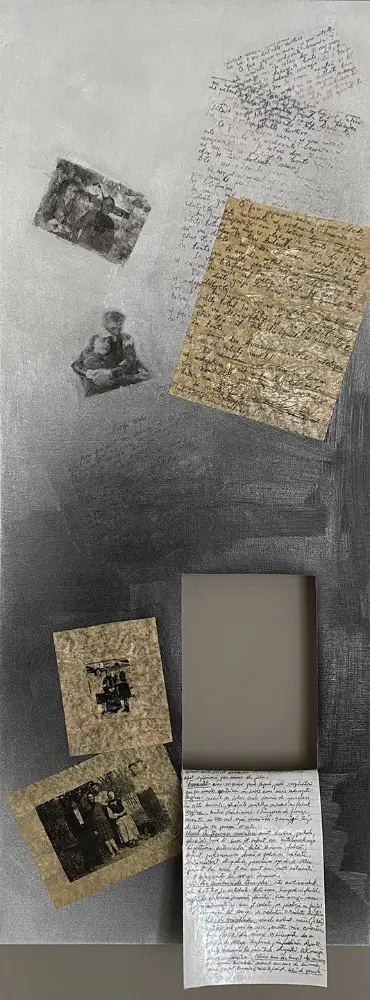
This work reflects on the emotional rupture produced by migration and prolonged separation from family. Faded photographs of parents and grandparents, together with fragments of handwritten letters once sent across borders, are embedded within a restrained surface of layered greys and worn textures. These elements function as fragile anchors of memory — evidence of care and continuity shaped by distance. A section of the canvas is physically cut and left hanging, introducing a gesture of unresolved tension. This torn fragment becomes a material embodiment of homesickness: a visual and spatial manifestation of the void carried within the self.
The absence is not symbolic decoration but structural loss — a wound that interrupts the integrity of the surface and alters the way the work is perceived. Charcoal marks and scraped paint reinforce the sense of erosion and endurance, suggesting how time reshapes both recollection and identity. Through the integration of personal archives and physical disruption, the piece transforms intimate history into a broader meditation on displacement, longing, and the lasting imprint of separation on the human psyche.
ABOUT THE ARTIST
Doina-Mihaela Iacob is a Romanian-born visual artist based in the United States whose practice investigates the material language of value, authority, and collective memory. Working primarily in mixed media, she transforms unconventional substances — including shredded currency, reclaimed industrial surfaces, and handmade paper — into works that operate at the intersection of conceptual art, social commentary, and tactile abstraction.
Her work challenges the assumed neutrality of economic symbols and institutional structures. By physically dismantling and reconfiguring money and other culturally coded materials, Iacob exposes the fragility of systems that shape identity, labor, and power. The resulting compositions are both architectural and intimate: surfaces carry traces of pressure, erosion, accumulation, and repair, suggesting histories that are simultaneously personal and systemic.
© Doina Iacob